Pigeon Navigation
The most comprehensive research studying pigeon navigation and homing behavior was conducted at Cornell University in the 1950s.
Early studies revealed that pigeons possess a form of internal compass. Years were spent on trying to understand its scientific
basis and function. What remains a mystery is the exact mechanism that enables homing pigeons to find their way back home from
hundred of miles away, while navigating through territory they have never been before. However, it is now believed that rather
than relying on a single navigational system, homing pigeons actually use a range of environmental cues. Recently the much
disputed theories of geomagnetic field orientation have gained new ground. Visual
cues such as three dimensional landmarks, as well as highways and buildings have also been found to play a role in pigeon
navigation. Pigeons appear to shift from one navigational method to another, depending upon the environmental conditions and
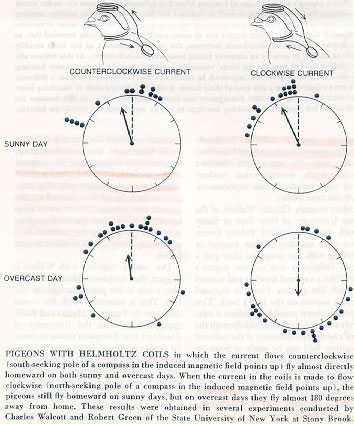
cues available to them. On cloudy days the geomagnetic field orientation takes precedence over the otherwise dominant "sun"
orientation method pigeons use when the sky is clear.





 -
- 